Introduction
combeanie is a simulation-first robotics project: a rail-mounted arm restocks cans and bottles into a refrigerated retail shelf from the rear. It is vendor-neutral, and its behaviour is checked by tests you can run.
After this page, go to How to run, then Fundamentals if the stack is new to you, then Architecture.
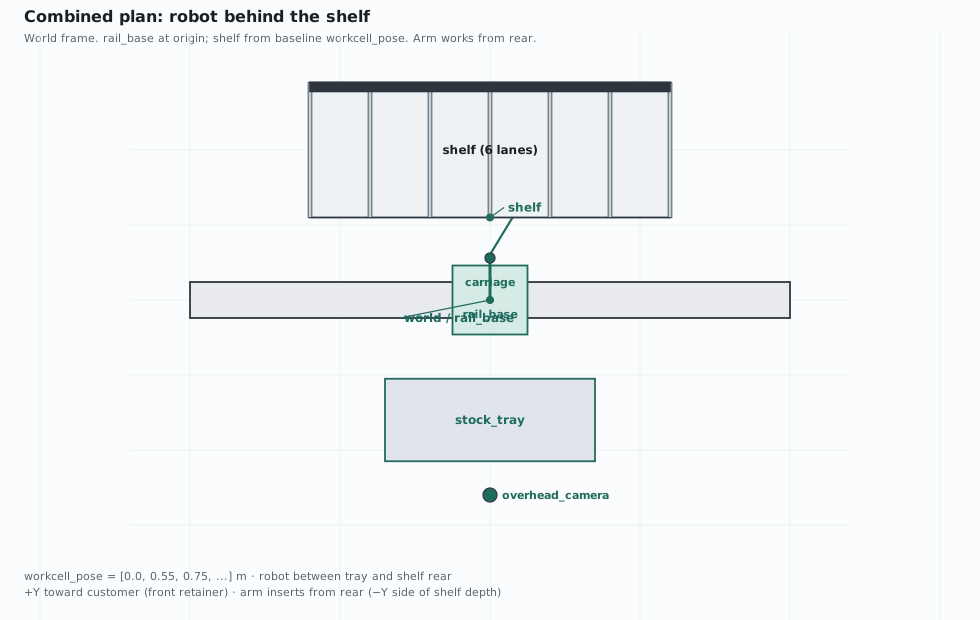
Static schematic. JavaScript and WebGL enable the optional interactive view.
The problem
Retail beverage shelves are restocked from behind the display: staff open the cabinet back, place cans and bottles into gravity-fed lanes, and products roll forward to the customer face. That work is repetitive, happens in a tight corridor behind the fridge, and must keep lanes sorted by product without wedging or tipping stock.
combeanie studies that job in simulation first: pick from a stock tray, plan a safe motion, place into a compatible lane mouth, and check the outcome in world state. If the outcome cannot be verified, the task refuses instead of guessing.
A restock succeeds only when world state shows the product in the intended lane. Collisions, lost reservations, stale geometry, and ambiguous perception stop the task.
Out of scope for now: physical store hardware, learned policies that command joints directly, and a single launch that turns every optional subsystem on without saying so.
The scenario
The default simulated cell is a rear-access refrigerated display:
| Element | Role |
|---|---|
| Gravity-fed shelf | Six lanes behind a front retainer; roller bed inclined about 4° so stock settles at the customer face |
| Stock tray | Staging area behind the shelf where products wait to be grasped |
| Rail-mounted arm | Travels along a rail behind the shelf so one arm covers every lane |
| Cameras | Overhead RGB-D mast (obstacle detection only) plus wrist camera (the sensor-driven default's product and lane evidence) |
Products in the catalog are cans and bottles of a few sizes. Lanes are paired by class so the task has a choice when one lane is full or blocked. Geometry comes from surveyed YAML, not invented mesh sizes.
World-frame plan with rail_base at the origin and the shelf at the baseline workcell pose
(0, 0.55, 0.75 m). The arm stands behind the shelf, between the stock tray and the lane mouths.

The robot
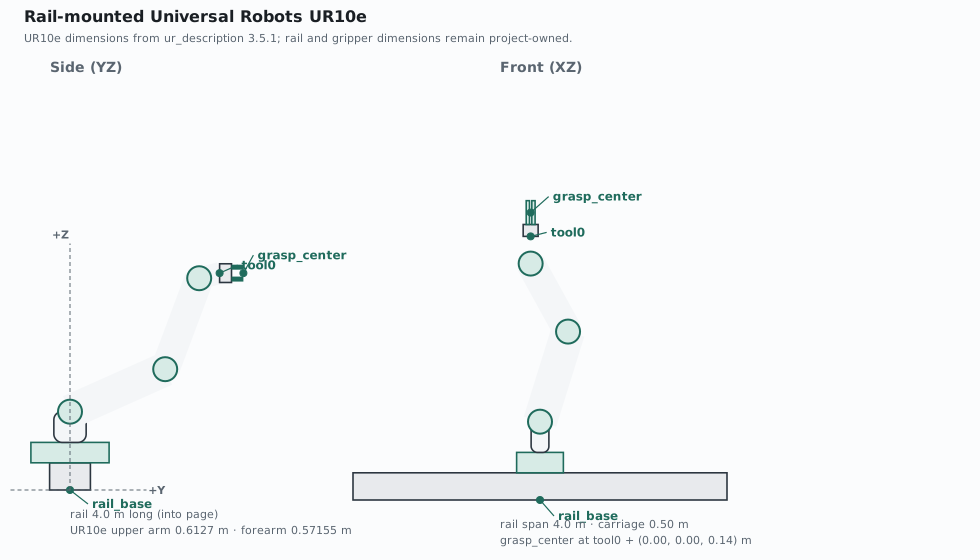
One arm covers the whole shelf by riding a horizontal rail behind the display. A carriage on
that rail carries a six-axis manipulator and a parallel-jaw gripper. The planning tip is
tool0; grasp geometry is centered on grasp_center, a fixed offset beyond the tool flange.
A decorative beanie (hence the name) sits on the shoulder cap: visual only, with no
collision, no mass, no effect on planning or perception.
Side (YZ) and front (XZ) views in the zero pose. Rail span is 4.0 m.
grasp_center sits 0.14 m beyond tool0 along the gripper axis.

| Frame | Meaning |
|---|---|
rail_base | Fixed rail origin in the world |
carriage | Sliding mount that carries the arm |
tool0 | MoveIt / control tip frame |
grasp_center | Where fingers close on a product |
beanie | Decorative shoulder-cap beanie (visual only) |
Drag to orbit, scroll to zoom, reset the camera from the toolbar. Switch between home
(upright) and a reach toward lane_03. Labels follow the visual components in each pose; they mark mesh centers, not TF origins.
The frame tree describes frame ancestry.
Static schematic. JavaScript and WebGL enable the optional interactive view.
The workcell
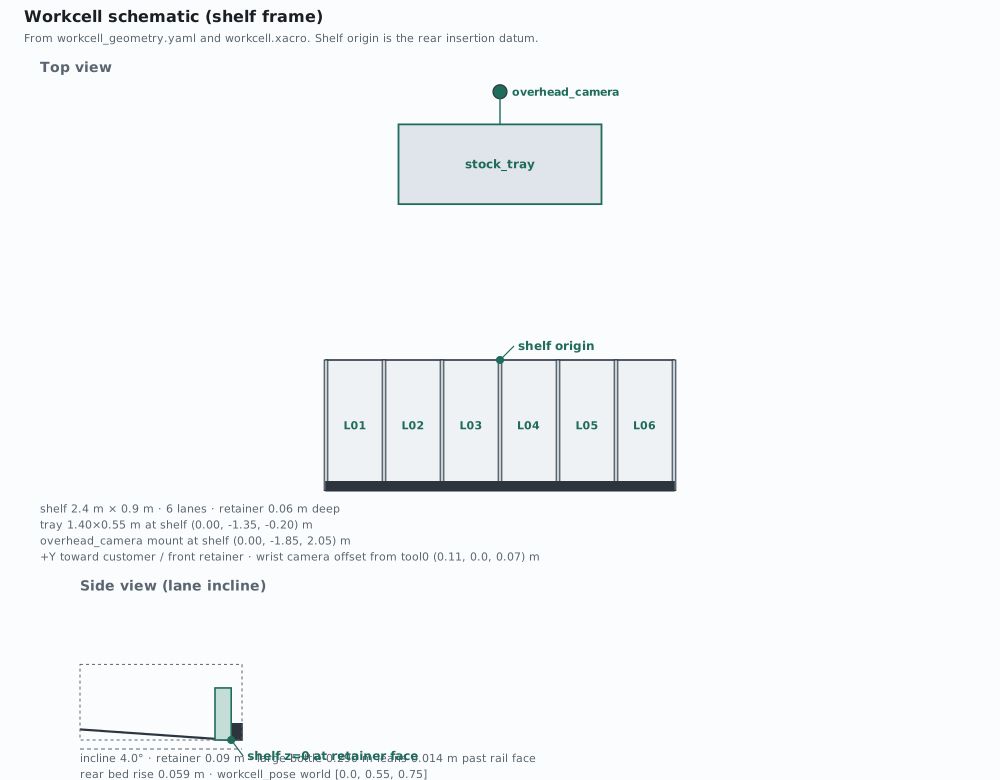
Six gravity-fed lanes, a front retainer, a stock tray, and an overhead camera mast. Products released near a lane mouth roll forward on the roller bed and settle against the retainer.
Top and side views (shelf z = 0 at the retainer face):

Lane cross-section: inclined bed, retainer, and a settled large bottle leaning with the bed.

Shelf, tray, mast, and the dense demo products:
Static schematic. JavaScript and WebGL enable the optional interactive view.
Stack
Gazebo Harmonic  +  ROS 2 Jazzy  +  ros2_control  +  MoveIt 2
        │
        └── Nix flake pins the toolchain; just drives build/test/launch
No host ROS install is required. Physical hardware is out of scope for this version.